Tap here


The traditional bro split, where each muscle is trained once per week, is being questioned by newer training research. Studies on training frequency suggest that weekly volume and effort matter more than how often a muscle is trained. Higher frequency programs may offer small advantages mainly by improving set quality and recovery distribution. The debate is not settled because both approaches can build muscle under the right conditions. What is changing is how coaches think about distributing volume rather than simply splitting body parts.


For decades, the bro split was the default bodybuilding structure:
Each muscle group trained once per week with high session volume.
This structure worked, and still works for many lifters. But modern hypertrophy research has shifted attention away from body part frequency and toward weekly volume distribution.
The question is no longer whether bro splits build muscle. The question is whether they are the most efficient way to do it.
Several meta-analyses, including work by Brad Schoenfeld and colleagues, have examined how often muscles should be trained per week.
The consistent finding is:
When weekly volume is matched, training frequency has little to no major effect on hypertrophy.
However, there are important details hidden inside that conclusion.
Higher frequency often leads to:
But when total sets are equal, frequency alone does not guarantee more growth.
This is where most misunderstandings come from.
A traditional bro split compresses all weekly volume for a muscle into a single session.
That creates a predictable problem:
By the end of a high-volume chest or leg session, performance drops. Load, speed, and output decline.
This leads to what researchers often refer to as “junk volume”: sets that contribute more fatigue than stimulus.
The issue is not that one session per week is ineffective. The issue is that quality declines as fatigue accumulates within that session.
Splitting the same weekly volume across more sessions changes the fatigue profile.
Instead of one high-fatigue session, you get:
This is why upper-lower and full-body programs became more popular in evidence-based coaching circles.
Not because they are inherently superior, but because they make it easier to maintain set quality.
Across nearly all hypertrophy literature, one variable consistently matters most:
Total weekly hard sets per muscle group
Training frequency mainly acts as a tool to manage that volume.
So the hierarchy looks more like this:
This is why both bro splits and higher-frequency programs can work.
Despite criticism, bro splits are not obsolete.
They can work well when:
They are also common among advanced lifters who naturally reduce frequency as fatigue sensitivity increases.
In some cases, reducing frequency is not a mistake. It is a recovery adjustment.
Higher frequency training has one underappreciated advantage: skill acquisition.
Repeating lifts more often improves:
This is especially relevant for compound lifts like squats, presses, and rows.
Bro splits reduce how often these movements are practiced. That can slow technical refinement for some lifters.
The research is clearer than the gym culture discussion.
Most studies show:
But real training is not volume-matched experiments.
Real programs include:
This is why bro splits still survive in practice even when evidence-based circles lean toward higher frequency models.
The current direction in programming is not “kill bro splits.”
It is more precise:
This is less about ideology and more about repeatable performance.
If total weekly volume and effort are equal, both approaches can build muscle. Higher frequency may help maintain better set quality, especially in intermediate lifters.
A structured plan like workout plans can help ensure volume is distributed properly rather than accumulated in one session.
Training split choice has minimal direct impact on fat loss. Energy balance remains the dominant factor. However, higher frequency training can increase weekly activity distribution, which may slightly affect adherence and fatigue management.
Higher frequency resistance training may support joint tolerance and movement practice, but evidence is not strong enough to make absolute claims.
The bro split is not “wrong.” It is simply no longer the default assumption.
What has changed is the understanding that:
The debate is less about structure and more about efficiency under fatigue.
Muscle can be built with both bro split and higher-frequency training as long as weekly volume and effort are sufficient. The main difference is how fatigue is managed across the week. Bro splits concentrate work into fewer sessions, which can reduce set quality late in workouts. Higher frequency spreads the same work out, often improving performance consistency. The practical decision is not which system is correct, but which one allows you to maintain progression without excessive fatigue.



Set calorie and macro goals, track your meals and activity, follow structured workout and meal plans, and monitor your progress over time. GetFIT App brings nutrition tracking, fitness planning, and everyday tools together in one simple membership.
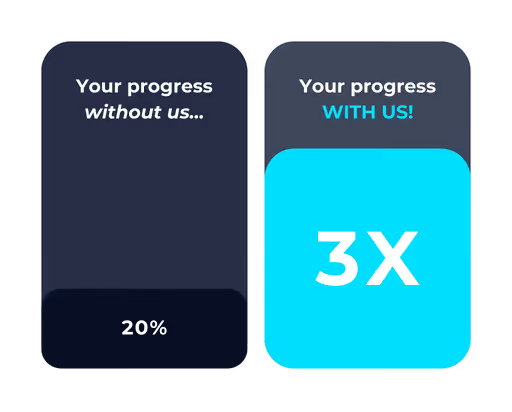
Thousands of people around the world have already joined GetFIT App to track their nutrition, follow workout programs, and work toward their fitness goals. Join our growing global community and get the tools you need to manage your fitness journey in one place.
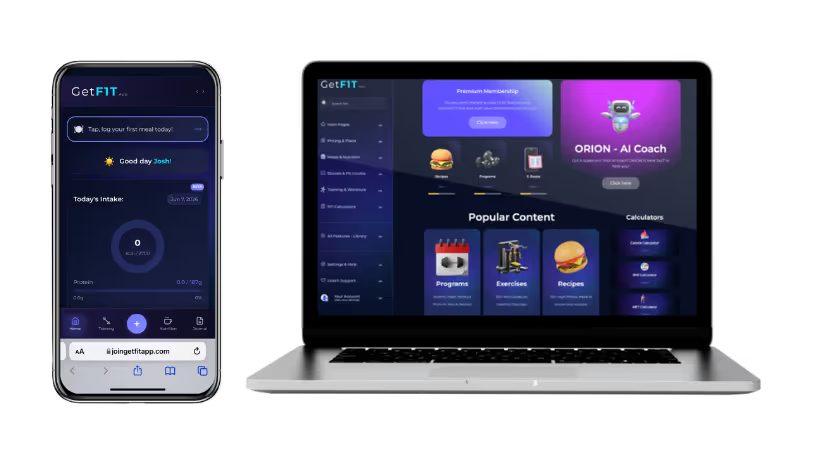
Track your daily calories and macros, log your workouts, monitor your weight and measurements, and see your progress over time. GetFIT App puts everything you need to stay on track in one place.

.webp)
Discover the premium features of the GetFIT App during a free trial: personalized calorie calculation and tracking, meal plans, recipes, workout programs, e-books, and much more. Start your transformation today!
.webp)
Start your free trial today! With your premium membership, you’ll get immediate access to all the tools and content that help you lose weight, build muscle, and develop a healthy lifestyle.











.avif)


.avif)



.avif)


.avif)















































.png)