Tap here


A growing group of strength coaches is reducing weekly training volume while still maintaining or improving muscle growth outcomes. This approach challenges the long-held belief that more sets automatically produce more hypertrophy. Research suggests there is a wide “minimum effective dose” range, and beyond it, returns begin to flatten. The shift is driven by fatigue management, recovery limits, and better programming precision. The debate now centers on whether most lifters train too much rather than too little.


For years, hypertrophy training has been guided by a simple idea: more weekly sets lead to more muscle growth.
That framework is now being questioned in applied strength coaching. Not because volume is ineffective, but because the relationship between volume and growth is not linear.
A growing number of coaches are experimenting with lower weekly set counts per muscle group, while maintaining intensity and tracking proximity to failure more precisely.
The surprising part is not that it works. It is that for some lifters, reducing volume improves progress.
Low-volume training does not mean training lightly. It usually refers to:
In many cases, lifters still train close to failure, often within 0 to 3 reps in reserve.
The difference is not effort. It is total accumulated workload.
Meta-analyses in resistance training research, including work by Brad Schoenfeld and colleagues, have consistently shown a dose-response relationship between weekly sets and hypertrophy.
However, the same research also shows:
This creates an important gap between evidence and programming.
It does not say that “high volume is always better.” It shows that more volume helps up to a point, then benefits become less predictable.
A key concept driving the current shift is minimum effective dose training.
Instead of asking “how much can I do,” coaches are asking:
This reframes hypertrophy training as a recovery-managed system rather than a volume-maximization system.
High-volume programs often work well in controlled studies. But in real-world training, variables stack up:
When these factors combine, high weekly volume can push lifters past their recovery capacity.
The result is not better adaptation. It is fatigue masking progress.
This is where low-volume approaches started gaining attention in coaching circles.
The key tension in modern hypertrophy programming is not stimulus. It is fatigue management.
Two competing ideas exist:
More sets create more opportunities for muscle protein synthesis.
Fewer sets allow higher quality effort and better recovery, which may improve long-term progression.
Both can be supported depending on context. The disagreement comes from how quickly fatigue accumulates in each model.
When volume is reduced, set quality becomes critical.
Low-volume training typically relies on:
Without these, low-volume training tends to underperform.
This is why it is not simply “doing less.” It is a shift toward higher signal per set.
The shift is not universal, but several trends are clear:
Instead of fixed set prescriptions, coaches adjust volume based on response.
Performance trends, soreness patterns, and fatigue markers are used more actively.
Training is structured in waves rather than static weekly prescriptions.
This reflects a broader move away from rigid bodybuilding templates.
Low-volume approaches tend to perform best in:
It is less effective when:
Despite growing interest, several gaps remain:
This means current conclusions are best described as probabilistic, not absolute.
Both high and low volume can build muscle. The deciding factor is whether weekly work is recoverable and progressively overloadable over time.
Training volume has a smaller direct effect on fat loss than energy balance. However, excessive volume can increase fatigue and reduce daily activity outside the gym. Tools like a calorie calculator are more directly relevant for fat loss outcomes.
Lower-volume resistance training may improve adherence and reduce overuse injuries in some populations, but long-term comparative data is still limited.
The most important change is not the rise of low-volume training itself.
It is the growing acceptance that hypertrophy has a threshold of sufficient stimulus, beyond which additional work may not produce proportional returns.
This challenges decades of bodybuilding intuition, where volume was often treated as the primary driver of progress.
Now the question is becoming more precise:
How much training is required to grow, recover, and repeat consistently?
Muscle growth does not require extremely high training volume, but it does require enough stimulus applied close to failure and repeated consistently over time. The shift toward low-volume training is not about doing less work, but about removing unnecessary fatigue that does not contribute to growth. For many lifters, progress improves when volume is adjusted to match recovery rather than ambition. The practical takeaway is simple: the best training volume is the one you can recover from while still progressing week to week.



Set calorie and macro goals, track your meals and activity, follow structured workout and meal plans, and monitor your progress over time. GetFIT App brings nutrition tracking, fitness planning, and everyday tools together in one simple membership.
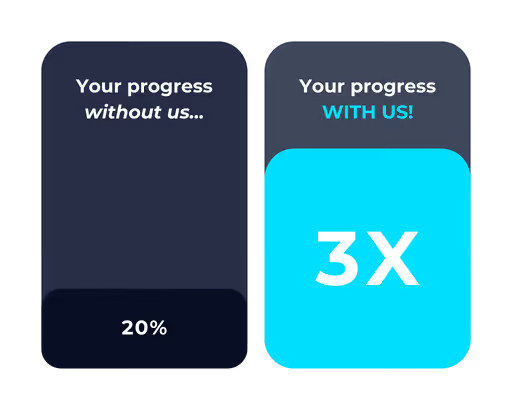
Thousands of people around the world have already joined GetFIT App to track their nutrition, follow workout programs, and work toward their fitness goals. Join our growing global community and get the tools you need to manage your fitness journey in one place.
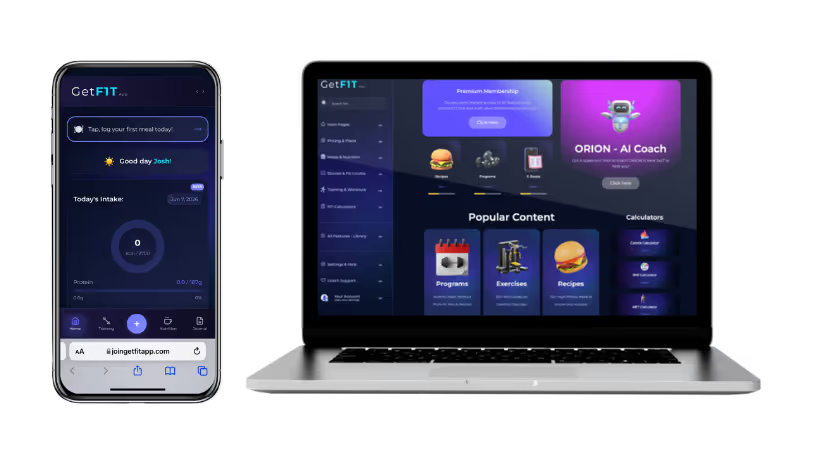
Track your daily calories and macros, log your workouts, monitor your weight and measurements, and see your progress over time. GetFIT App puts everything you need to stay on track in one place.

.webp)
Discover the premium features of the GetFIT App during a free trial: personalized calorie calculation and tracking, meal plans, recipes, workout programs, e-books, and much more. Start your transformation today!
.webp)
Start your free trial today! With your premium membership, you’ll get immediate access to all the tools and content that help you lose weight, build muscle, and develop a healthy lifestyle.









.avif)


.avif)



.avif)


.avif)















































.png)