Tap here


After 40, muscle and strength gains slow down mainly due to reduced recovery capacity, changes in hormone levels, lower training consistency, and years of accumulated lifestyle factors. It is not that muscle building stops, but the margin for error becomes smaller. Many men train too hard without enough recovery, protein intake, or structured progression, which limits results. Research shows that resistance training still works very effectively in older adults when volume, intensity, and recovery are properly managed. With the right approach, men over 40 can still build significant strength and muscle, but the strategy must be more precise than in younger years.


The idea that strength “stops” after 40 is incorrect. What actually changes is the balance between stimulus and recovery.
Muscle growth depends on three main drivers:
After 40, all three still work, but recovery becomes the limiting factor more often than training stimulus.
One of the biggest shifts is recovery speed. Connective tissue, muscle repair processes, and overall systemic recovery take longer.
This does not mean training is less effective. It means:
The same workout that a 25-year-old recovers from in 48 hours might take 72 to 96 hours at 40+.
Testosterone levels gradually decline with age, but the drop is often exaggerated in fitness culture.
Most healthy men do not experience a sudden hormonal collapse at 40. Instead, there is a slow decline combined with lifestyle factors such as:
These factors often matter more than age alone.
Even with lower average testosterone levels, resistance training still strongly stimulates muscle protein synthesis.
The key point is this:
Training response remains high, but recovery efficiency becomes more sensitive to lifestyle factors.
This is why some men over 40 continue progressing while others stall completely.
Many men over 40 are not starting fresh. They are dealing with 10 to 20 years of inconsistent training habits.
Common patterns include:
The issue is not age. It is accumulated inconsistency.
Younger trainees can often recover from high volume quickly. After 40, excessive volume becomes counterproductive faster.
More training is not always better. Better recovery of training is what matters.
Protein still builds muscle effectively, but older adults benefit more from:
For practical use, tools like the protein calculator help set accurate intake targets based on lean mass and activity level.
Sleep is one of the most underestimated factors in muscle gain after 40.
Even small reductions in deep sleep affect:
A consistent sleep routine becomes a performance tool, not just a health habit.
Many men over 40 try to do everything at once:
The result is not overtraining in the traditional sense, but under-recovery combined with inconsistent energy levels.
This is where training stops producing visible progress.
Despite all limitations, research on resistance training in older adults consistently shows one thing:
Muscle and strength can still increase significantly at any age.
Even previously untrained individuals in their 40s, 50s, and 60s can gain noticeable muscle mass and strength within months when training is structured correctly.
The limiting factor is not biology alone. It is programming.
Many men continue using:
This leads to stagnation, not progress.
Progression often becomes unclear.
Without structured overload:
Muscle growth requires measurable progression over time.
Muscles adapt faster than connective tissue.
This creates a mismatch:
The result is pain, inflammation, and reduced training consistency.
More is not better. Effective training focuses on the smallest amount of volume needed for growth.
A typical effective structure:
Key movements:
Isolation work still matters, but should not dominate the program.
Recovery should be treated like programming:
Ignoring recovery is equivalent to skipping workouts.
Nutrition becomes more important, not less.
Key adjustments:
For individuals trying to balance fat loss and muscle gain, tools like the calorie calculator and macronutrient calculator help remove guesswork.
Cardio is often avoided due to fear of “losing gains,” but this is outdated thinking.
Properly programmed cardio:
The issue is not cardio itself, but excessive cardio without recovery balance.
The biggest misconception is that men over 40 need completely different training.
They do not.
They need:
Strength training still works. It just requires precision.
Most strength plateaus after 40 are not caused by aging alone. They are caused by a mismatch between training stress and recovery capacity. The body still responds extremely well to resistance training, but only when volume, sleep, nutrition, and progression are properly managed. Men who adjust their approach rather than trying to train harder often start making progress again within weeks. The key shift is moving from maximum effort training to sustainable, structured training.



Set calorie and macro goals, track your meals and activity, follow structured workout and meal plans, and monitor your progress over time. GetFIT App brings nutrition tracking, fitness planning, and everyday tools together in one simple membership.
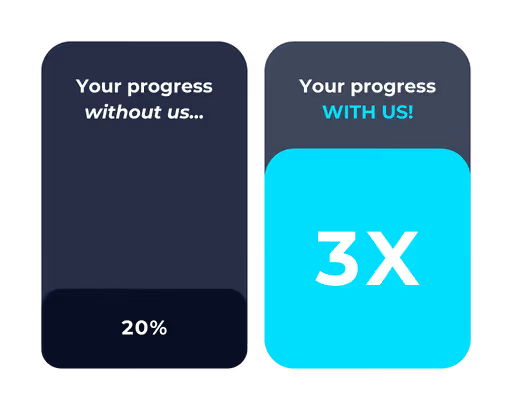
Thousands of people around the world have already joined GetFIT App to track their nutrition, follow workout programs, and work toward their fitness goals. Join our growing global community and get the tools you need to manage your fitness journey in one place.
Track your daily calories and macros, log your workouts, monitor your weight and measurements, and see your progress over time. GetFIT App puts everything you need to stay on track in one place.


.webp)
Discover the premium features of the GetFIT App during a free trial: personalized calorie calculation and tracking, meal plans, recipes, workout programs, e-books, and much more. Start your transformation today!
.webp)
Start your free trial today! With your premium membership, you’ll get immediate access to all the tools and content that help you lose weight, build muscle, and develop a healthy lifestyle.











.avif)


.avif)


.avif)


.avif)















































.png)