Sumo deadlift uses a wider stance to target the inner thighs and glutes. Keep the weight close to your body and focus on technique.

Train & diet effectively with the help of the GetFIT App. Our app tracks your calorie intake and workouts, and offers effective plans, recipes, and programs.

(Free trial for new users - cancel anytime)
Our Meal Plans


Blog Articles









Blog Articles
Sumo Deadlift – Lower Body Strength and Glute-Focused Power Development
The sumo deadlift is a fundamental strength training exercise that primarily targets the glutes, inner thighs, and posterior chain. Due to the wide stance and outward foot positioning, the torso remains more upright compared to the conventional deadlift, which can reduce stress on the lower back for many lifters.
This makes it an excellent choice for building glute-dominant strength and improving overall lower body performance.
Benefits Compared to Similar Exercises
Strong Glute Activation
The wide stance significantly increases activation of the gluteus maximus.
Inner Thigh Development
Strongly engages the adductor muscles, which are often undertrained in many lower body movements.
Potentially Lower Lower Back Stress
The more upright torso position can reduce spinal shear forces compared to conventional deadlifts.
Shorter Range of Motion
Allows the use of heavier loads due to a reduced lifting distance.
Muscles Worked
Primary Muscles
- Gluteus maximus (glutes)
- Adductor muscles (inner thighs)
Secondary Muscles
- Hamstrings (rear thighs)
- Erector spinae (lower back)
- Core muscles
- Upper back and traps (stabilization)
How to Perform the Sumo Deadlift Correctly
Starting Position
- Stand with a wide stance
- Turn your feet outward (30–45 degrees)
- Position the bar over the mid-foot
Setup and Grip
- Grip the bar with hands inside your legs
- Position shoulders directly above the bar
Lifting Phase
- Keep your chest lifted and spine neutral
- Push your knees outward in line with your toes
- Drive through the floor with your legs
- Keep the bar close to your body throughout the lift
Lockout Position
- Fully extend your hips
- Squeeze your glutes at the top
Lowering Phase
- Push your hips back in a controlled hip hinge
- Lower the bar slowly while maintaining control
Breathing and Core Stability
- Take a deep breath into your abdomen before lifting (brace your core)
- Hold tension throughout the lift
- Exhale at the top or after completing the repetition
Range of Motion
- Bar starts on the floor
- Lift ends at full hip extension
- Range of motion is shorter than in a conventional deadlift
Variations and Progression Levels
Beginner
- Kettlebell sumo deadlift
- Elevated bar (rack pull variation)
Intermediate
- Standard sumo deadlift
Advanced
- Deficit sumo deadlift
- Paused sumo deadlift
- Low-rep heavy strength work
When to Use It in Your Workout
- At the beginning of a lower body training session
- As a primary strength movement
- In glute-focused training programs
Alternative Exercises
- Conventional deadlift
- Romanian deadlift (RDL)
- Hip thrust
- Kettlebell deadlift
Recommended Sets, Reps, and Rest
Beginners
- Sets: 3–4
- Reps: 6–10
- Rest: 2–3 minutes
Advanced Lifters
- Sets: 4–5
- Reps: 3–6
- Rest: 2–3+ minutes
Sample Lower Body Strength Workout
- Sumo deadlift – 4 × 6
- Squat – 3 × 8–10
- Hip thrust – 3 × 10–12
Common Mistakes and How to Fix Them
Knees Collapsing Inward
Actively push your knees outward throughout the movement.
Bar Drifting Away from the Body
Keep the bar close to your legs at all times.
Rounded Back
Maintain a neutral spine and strong core tension.
Hips Rising Too Fast
Ensure hips and shoulders rise together to maintain proper mechanics.
The sumo deadlift is a highly effective compound exercise for building stronger glutes, improving lower body strength, and developing a more stable and powerful posterior chain.

More Exercises
All Exercises
.avif)


.avif)


.avif)

.avif)


.avif)
.avif)


.avif)





Everything You Need for a Fitter Body is here in GetFIT App!
Set calorie and macro goals, track your meals and activity, follow structured workout and meal plans, and monitor your progress over time. GetFIT App brings nutrition tracking, fitness planning, and everyday tools together in one simple membership.
High-Protein Recipes & Meal Plans
Discover hundreds of high-protein recipes, ready-made 4 week meal plans, and healthy meal ideas for weight loss and muscle building. Every recipe includes clear calorie and macro information, so eating for your goals is simple.


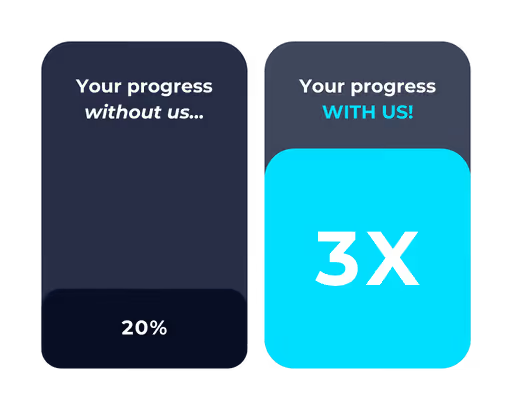
Join Thousands of GetFIT App Users Worldwide
Thousands of people around the world have already joined GetFIT App to track their nutrition, follow workout programs, and work toward their fitness goals. Join our growing global community and get the tools you need to manage your fitness journey in one place.
.webp)
Try GetFIT App for 5 days free!
Discover the premium features of the GetFIT App during a free trial: personalized calorie calculation and tracking, meal plans, recipes, workout programs, e-books, and much more. Start your transformation today!
.webp)
Dear User! Unlock your Dream Body Today!
Start your free trial today! With your premium membership, you’ll get immediate access to all the tools and content that help you lose weight, build muscle, and develop a healthy lifestyle.















































.png)