.avif)
Leg press is a fundamental lower-body exercise that allows safe use of heavy weights. Maintain lower back stability and proper foot placement.

Train & diet effectively with the help of the GetFIT App. Our app tracks your calorie intake and workouts, and offers effective plans, recipes, and programs.

(Free trial for new users - cancel anytime)
Our Meal Plans


Blog Articles







Blog Articles
Leg Press – One of the Most Fundamental Machines for Lower Body Development
The leg press is a machine-based lower body exercise where you push a weighted platform away from your body while your back stays supported against a padded seat. The movement is simple in structure, but highly effective for building strength and muscle in the legs when performed with proper control and range of motion.
It is often used as a primary lower body builder because it allows heavy loading without the same balance demands as free-weight squats.
Why the Leg Press Is So Effective
The main advantage of the leg press is stability. Because your back is fully supported, you can focus entirely on pushing force through your legs without worrying about balance or torso control. This makes it easier to apply higher loads and accumulate volume.
It is also highly adaptable. Small changes in foot position can shift the emphasis between quads, glutes, and inner thighs, which makes it useful for different training goals.
For beginners, it offers a controlled way to build leg strength. For advanced lifters, it becomes a tool for progressive overload without spinal loading.
Muscles Worked
The primary muscles involved are the quadriceps and glutes. These two muscle groups drive most of the force during the pressing phase.
The hamstrings assist in controlling the movement, especially during the lowering phase. The adductors contribute when the feet are placed wider, and the calves provide additional support through ankle extension during the press.
How to Perform the Leg Press Correctly
Set yourself in the machine with your back and hips fully supported against the pad. Your feet should be placed on the platform at about shoulder width, with toes pointing slightly outward or straight depending on comfort and emphasis.
Lower the platform in a controlled manner by bending your knees. The key is to keep your knees tracking in the same direction as your toes, without letting them collapse inward. You should go as deep as you can while still maintaining full contact between your lower back and the seat.
From the bottom position, press the platform back up by driving through your entire foot, not just the toes or heels. The movement should feel smooth and continuous, without bouncing at the bottom.
At the top, avoid locking the knees completely. Keeping a slight bend maintains tension in the muscles and reduces unnecessary joint stress.
Breathing stays consistent. You inhale as you lower the weight and exhale as you press it back up.
Movement Control and Range
Depth is important, but only within a range where your lower back stays stable against the seat. If your hips start to lift or your back rounds, the range is too deep.
The goal is controlled tension through the entire movement, not just moving the weight from point A to point B. Smooth tempo and consistent pressure on the platform matter more than load alone.
Variations and Adjustments
Foot placement changes the stimulus significantly. A narrower stance tends to shift more load toward the quadriceps, while a wider stance increases glute and inner thigh involvement. Placing the feet higher on the platform generally reduces knee stress and shifts emphasis more toward the glutes and hamstrings.
Single-leg leg press variations are also used to correct strength imbalances and increase unilateral control.
Beginners benefit from lighter loads and shorter ranges of motion until they build confidence and stability. Advanced lifters often use heavier loads, slower eccentrics, or higher-rep sets for metabolic stress.
When to Use It
The leg press is commonly used as a main strength or hypertrophy movement on leg day. It can also serve as a substitute for squats when spinal loading needs to be reduced or when additional volume is required without technical fatigue.
It fits well both early in a workout for heavy work and later as a high-rep muscle-building exercise.
Common Mistakes
One of the most common issues is allowing the lower back to lift off the seat during deep reps. This shifts stress away from the legs and increases injury risk.
Using too much weight often leads to shortened range of motion and bouncing out of the bottom position, which reduces muscle activation and increases joint stress.
Another frequent mistake is letting the knees cave inward during the press, which creates instability and poor force alignment.
Locking the knees at the top is also unnecessary and can place stress on the joint without adding training benefit.
The leg press remains one of the most reliable tools for building lower body size and strength, especially when used with controlled depth, stable positioning, and consistent technique.

More Exercises
All Exercises
.avif)


.avif)


.avif)

.avif)


.avif)
.avif)


.avif)



Everything You Need for a Fitter Body is here in GetFIT App!
Set calorie and macro goals, track your meals and activity, follow structured workout and meal plans, and monitor your progress over time. GetFIT App brings nutrition tracking, fitness planning, and everyday tools together in one simple membership.
High-Protein Recipes & Meal Plans
Discover hundreds of high-protein recipes, ready-made 4 week meal plans, and healthy meal ideas for weight loss and muscle building. Every recipe includes clear calorie and macro information, so eating for your goals is simple.


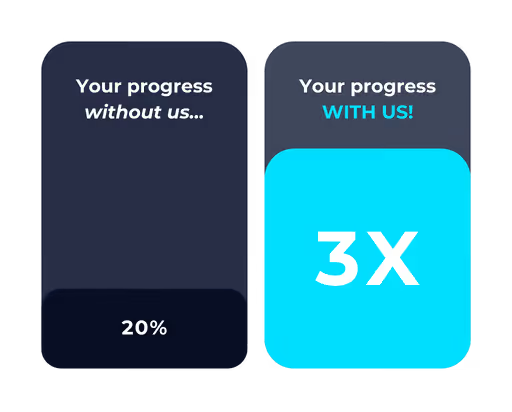
Join Thousands of GetFIT App Users Worldwide
Thousands of people around the world have already joined GetFIT App to track their nutrition, follow workout programs, and work toward their fitness goals. Join our growing global community and get the tools you need to manage your fitness journey in one place.
.webp)
Try GetFIT App for 5 days free!
Discover the premium features of the GetFIT App during a free trial: personalized calorie calculation and tracking, meal plans, recipes, workout programs, e-books, and much more. Start your transformation today!
.webp)
Dear User! Unlock your Dream Body Today!
Start your free trial today! With your premium membership, you’ll get immediate access to all the tools and content that help you lose weight, build muscle, and develop a healthy lifestyle.














































.png)