Paused deadlift improves strength and technique at critical points of the lift. Pause below the knees and control the weight.

Train & diet effectively with the help of the GetFIT App. Our app tracks your calorie intake and workouts, and offers effective plans, recipes, and programs.

(Free trial for new users - cancel anytime)
Our Meal Plans


Blog Articles







Blog Articles
Pause Deadlift – Building Strength and Control at Your Weakest Point
The pause deadlift is a more advanced variation of the conventional deadlift where you deliberately stop the barbell for a short moment during the lift, usually just below the knee or right after the bar leaves the floor. By removing momentum at this point, the exercise forces you to rely purely on strength and positioning, which makes it one of the most effective tools for improving technique and breaking through sticking points.
What makes this variation so valuable is that it exposes exactly where your lift breaks down. Once the bar is forced to stop under load, your body has no choice but to stay tight, stable, and properly aligned before completing the movement.
Why the Pause Deadlift Is So Effective
The biggest advantage of the pause deadlift is how much it improves strength in the most difficult part of the lift, especially the initial pull from the ground. Because you cannot rely on momentum, your body has to generate force from a dead stop, which directly improves starting strength.
It also reinforces proper technique. When the bar is paused, any weakness in posture, bar path, or bracing becomes obvious. Over time, this builds a much cleaner and more controlled deadlift pattern.
Another key benefit is the increased time under tension. The muscles stay engaged for longer, which improves both strength and muscle growth. On top of that, grip strength and core stability are heavily challenged throughout the entire movement.
Muscles Worked
The pause deadlift engages nearly the entire posterior chain. The glutes and hamstrings do most of the heavy lifting, especially during the initial pull and lockout phase.
The lower back muscles, particularly the erector spinae, work continuously to keep the spine stable. The lats help keep the bar close to the body, while the traps and upper back stabilize the shoulders and maintain posture. The core plays a constant role in resisting spinal flexion and keeping the torso rigid under load.
How to Perform the Pause Deadlift Correctly
You begin by setting up the same way as a conventional deadlift. Stand over the bar so it is positioned over the middle of your foot, then grip it slightly wider than shoulder width. Before the lift even begins, brace your core hard and set your back so the spine stays neutral.
As you initiate the pull, the bar should travel as close to your body as possible. Once it reaches the pause point, typically just below the knee or mid-shin depending on the goal, you stop completely for one to two seconds. The important detail here is that nothing relaxes during the pause. The body stays fully engaged, as if the lift is still moving.
After the pause, you continue the movement by driving through the floor and extending the hips until you reach a fully locked-out position. The descent should always be controlled, never dropped.
Breathing follows a simple pattern. You take a deep breath and brace before the lift begins, hold that tension through the pause, and exhale once you have completed the repetition.
Variations and Progression
The most common version is the pause just below the knee, but the pause can also be placed immediately after the bar leaves the floor for more emphasis on starting strength. Some advanced lifters even use multiple pauses within a single repetition to increase difficulty and control.
Beginners should focus on lighter weights and shorter pauses, usually around one second, while prioritizing perfect positioning. More advanced lifters can extend the pause to two or three seconds and gradually increase load while maintaining strict form.
When to Use the Pause Deadlift
This variation is especially useful if your deadlift breaks down off the floor or if you struggle to maintain proper positioning under heavy load. It fits well into strength-focused programs and can be used either as a main lift or as an accessory movement after conventional deadlifts.
It is also a strong tool for technical development, especially for lifters who tend to rush the pull or lose tightness during the first phase of the lift.
Common Mistakes
One of the most common issues is letting the bar drift away from the body, which immediately increases stress on the lower back and reduces lifting efficiency. Another frequent mistake is relaxing during the pause, which completely defeats the purpose of the exercise.
Using too much weight is also a problem, as it forces lifters to shorten the pause or lose proper positioning. A controlled, lighter load will always produce better long-term strength gains than a heavy, sloppy lift.
Summary
The pause deadlift is one of the most effective variations for building real strength where it matters most. By forcing control at the weakest point of the lift, it develops better technique, stronger starting power, and a more stable and efficient deadlift overall.

More Exercises
All Exercises
.avif)


.avif)


.avif)

.avif)


.avif)
.avif)


.avif)
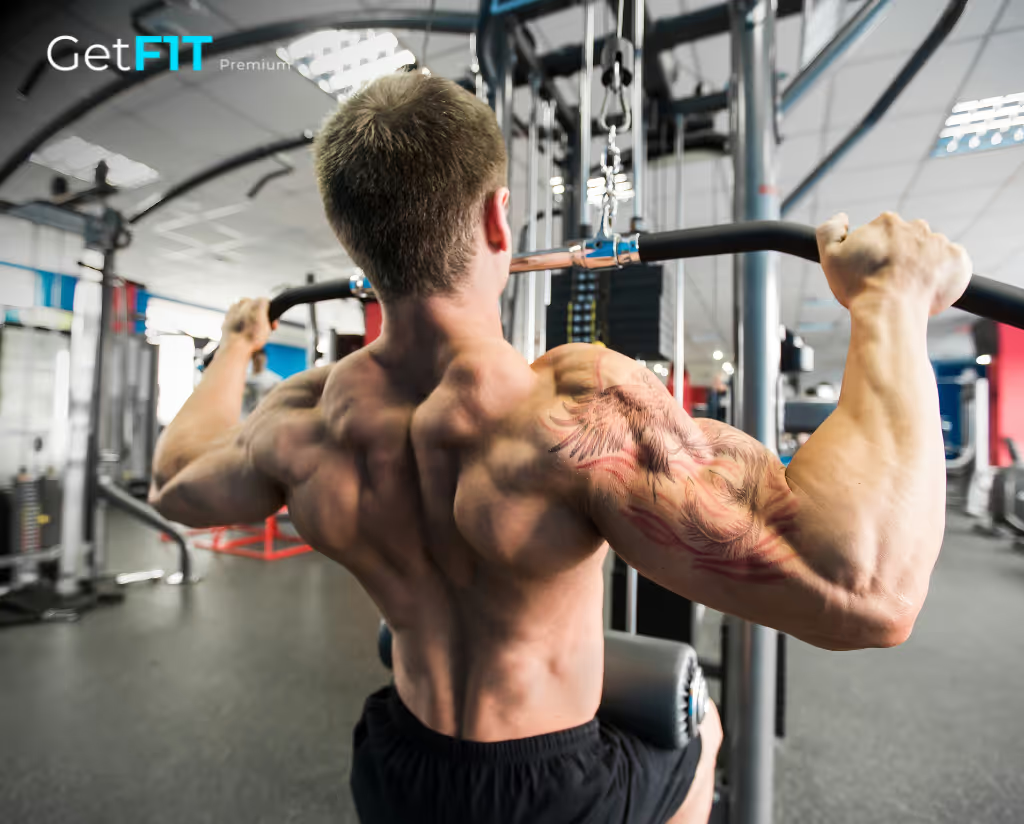




Everything You Need for a Fitter Body is here in GetFIT App!
Set calorie and macro goals, track your meals and activity, follow structured workout and meal plans, and monitor your progress over time. GetFIT App brings nutrition tracking, fitness planning, and everyday tools together in one simple membership.
High-Protein Recipes & Meal Plans
Discover hundreds of high-protein recipes, ready-made 4 week meal plans, and healthy meal ideas for weight loss and muscle building. Every recipe includes clear calorie and macro information, so eating for your goals is simple.


Join Thousands of GetFIT App Users Worldwide
Thousands of people around the world have already joined GetFIT App to track their nutrition, follow workout programs, and work toward their fitness goals. Join our growing global community and get the tools you need to manage your fitness journey in one place.
.webp)
Try GetFIT App for 5 days free!
Discover the premium features of the GetFIT App during a free trial: personalized calorie calculation and tracking, meal plans, recipes, workout programs, e-books, and much more. Start your transformation today!
.webp)
Dear User! Unlock your Dream Body Today!
Start your free trial today! With your premium membership, you’ll get immediate access to all the tools and content that help you lose weight, build muscle, and develop a healthy lifestyle.















































.png)