.avif)
Preacher curl isolates the biceps and minimizes cheating. Perform it slowly through a full range of motion.

Train & diet effectively with the help of the GetFIT App. Our app tracks your calorie intake and workouts, and offers effective plans, recipes, and programs.

(Free trial for new users - cancel anytime)
Our Meal Plans


Blog Articles


Blog Articles

Preacher Curl – Maximum Biceps Isolation
The preacher curl (also known as the Scott curl) is one of the most effective isolation exercises for building the biceps. By fixing the upper arm against an angled pad, momentum is minimized, forcing the biceps to perform most of the work.
Because the arm remains supported throughout the movement, the preacher curl is particularly effective for emphasizing the stretched position and maintaining constant tension on the muscle.
Benefits of the Preacher Curl
Maximum Isolation
The fixed arm position minimizes cheating and reduces momentum, allowing the biceps to remain under constant tension.
Continuous Muscle Tension
The exercise provides excellent tension throughout the range of motion, helping to stimulate muscle growth.
Improves Exercise Technique
Since swinging and body movement are minimized, the preacher curl encourages strict form and better mind-muscle connection.
Beginner-Friendly
The supported position makes the movement easier to control and safer for beginners.
Muscles Worked
Primary Muscles
- Biceps brachii
- Brachialis
Secondary Muscles
- Brachioradialis
- Forearm muscles
- Minimal shoulder stabilization
How to Perform the Preacher Curl Correctly
Starting Position
Sit behind the preacher bench and place the entire upper arm firmly against the pad. Your armpits should be close to the top edge of the bench.
Movement Execution
- Grip the bar or dumbbell with an underhand (supinated) grip.
- Lower the weight slowly until your arms are almost fully extended.
- Keep a slight bend in the elbows rather than locking them completely.
- Curl the weight upward toward your shoulders.
- Squeeze the biceps at the top position.
- Lower the weight slowly and under control.
Breathing Technique
- Inhale during the lowering phase.
- Exhale while curling the weight upward.
Range of Motion and Technique Tips
- Control the eccentric (lowering) phase.
- Keep the elbows firmly against the pad throughout the set.
- Avoid using the shoulders to assist the movement.
- Do not fully lock out the elbows to reduce joint stress.
- Focus on smooth, controlled repetitions.
Variations and Difficulty Levels
Variations
- EZ-bar preacher curl
- Single-arm dumbbell preacher curl
- Cable preacher curl
- Reverse-grip preacher curl (greater forearm emphasis)
Beginner Options
- Use lighter weights
- Perform slow, controlled repetitions
Advanced Options
- Drop sets
- Slow eccentrics (3–4 seconds)
- Partial repetitions
- Rest-pause sets
When to Use the Preacher Curl
The preacher curl works particularly well:
- At the end of a biceps workout as an isolation exercise
- For improving exercise form
- As a high-repetition finisher
- To maximize muscle pump and mind-muscle connection
Alternative Exercises
If you want variety, consider:
- Standing Barbell Curl
- Cable Curl
- Hammer Curl
- Concentration Curl
- Incline Dumbbell Curl
Recommended Sets, Reps, and Rest Periods
- Sets: 3–4
- Repetitions: 8–12
- Rest: 45–75 seconds
Sample Arm Workout
- Standing Barbell Curl – 3 × 10
- Preacher Curl – 3 × 12
- Hammer Curl – 3 × 10
Common Mistakes and How to Avoid Them
Lifting the Elbows Off the Pad
Problem: Reduces isolation and allows other muscles to assist.
Solution: Keep the upper arms firmly supported throughout the movement.
Using Too Much Weight
Problem: Leads to poor technique and momentum.
Solution: Choose a weight that allows strict, controlled repetitions.
Locking Out the Elbows Completely
Problem: Places unnecessary stress on the elbow joint.
Solution: Maintain a slight bend at the bottom position.
Lowering the Weight Too Quickly
Problem: Reduces muscle tension and training effectiveness.
Solution: Slow down the eccentric phase and maintain control.
Pro Tip
The preacher curl is not a movement for lifting the heaviest possible weight. Instead, focus on strict execution, controlled eccentrics, and squeezing the biceps hard at the top of each repetition. Using moderate weights with perfect form often produces better muscle growth than using heavy weights with momentum.
Summary
The preacher curl is one of the best exercises for achieving strict biceps isolation and maximizing muscle tension. By minimizing momentum and emphasizing controlled movement, it can be a highly effective tool for building bigger, stronger, and more well-developed arms.

More Exercises
All Exercises
.avif)


.avif)


.avif)

.avif)


.avif)
.avif)


.avif)



Everything You Need for a Fitter Body is here in GetFIT App!
Set calorie and macro goals, track your meals and activity, follow structured workout and meal plans, and monitor your progress over time. GetFIT App brings nutrition tracking, fitness planning, and everyday tools together in one simple membership.
High-Protein Recipes & Meal Plans
Discover hundreds of high-protein recipes, ready-made 4 week meal plans, and healthy meal ideas for weight loss and muscle building. Every recipe includes clear calorie and macro information, so eating for your goals is simple.


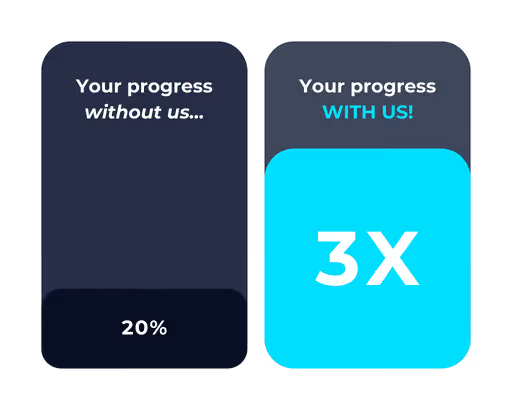
Join Thousands of GetFIT App Users Worldwide
Thousands of people around the world have already joined GetFIT App to track their nutrition, follow workout programs, and work toward their fitness goals. Join our growing global community and get the tools you need to manage your fitness journey in one place.
.webp)
Try GetFIT App for 5 days free!
Discover the premium features of the GetFIT App during a free trial: personalized calorie calculation and tracking, meal plans, recipes, workout programs, e-books, and much more. Start your transformation today!
.webp)
Dear User! Unlock your Dream Body Today!
Start your free trial today! With your premium membership, you’ll get immediate access to all the tools and content that help you lose weight, build muscle, and develop a healthy lifestyle.















































.png)