.avif)
Russian twists are effective for developing the obliques. Perform them in a controlled manner and avoid using momentum.

Train & diet effectively with the help of the GetFIT App. Our app tracks your calorie intake and workouts, and offers effective plans, recipes, and programs.

(Free trial for new users - cancel anytime)
Our Meal Plans


Blog Articles








Blog Articles

Russian Twist – Oblique Strength and Rotational Core Stability
The Russian Twist is a classic core exercise designed to strengthen the obliques while improving rotational stability and overall trunk control. It is particularly useful for developing a strong midsection, enhancing athletic performance, and building a more defined waistline.
Benefits of the Russian Twist Compared to Other Core Exercises
Targeted Oblique Activation
The Russian Twist is one of the most effective exercises for training the external and internal obliques, providing rotational work that many traditional abdominal exercises lack.
Improves Core Stability and Control
By resisting and controlling rotation, this exercise helps strengthen the muscles responsible for stabilizing the spine during movement.
Enhances Coordination and Balance
Maintaining a stable torso while rotating challenges both the nervous system and the muscles, improving body awareness and coordination.
Minimal Equipment Required
The exercise can be performed using only body weight or progressed with dumbbells, weight plates, medicine balls, or kettlebells.
Muscles Worked
Primary Muscles
- External obliques
- Internal obliques
Secondary Muscles
- Rectus abdominis
- Transverse abdominis
- Deep core stabilizers
- Hip flexors (to a lesser extent)
How to Perform the Russian Twist Correctly
Starting Position
Sit on the floor with your knees bent and your feet positioned comfortably in front of you. Lean your torso slightly backward while maintaining a neutral spine and an upright chest.
Foot Position
- Beginners can keep their feet on the floor.
- Advanced trainees may lift their feet off the ground to increase the challenge.
Holding the Weight
Hold a weight plate, dumbbell, medicine ball, or kettlebell in front of your chest. Bodyweight-only variations are also effective for beginners.
Rotation
Rotate your torso to one side, then to the opposite side.
The movement should come from the trunk rather than simply moving the arms.
Controlled Execution
Perform each repetition slowly and deliberately. Avoid using momentum and focus on feeling the obliques working throughout the movement.
Breathing Technique
- Exhale as you rotate to either side.
- Inhale as you return to the center.
Range of Motion and Technique Tips
- Rotate from the torso rather than bending sideways.
- Turn only as far as you can while maintaining control.
- Keep your chest elevated and spine neutral.
- Avoid excessive leaning backward, which can place unnecessary stress on the lower back.
- Focus on quality and control instead of speed.
Variations and Difficulty Levels
Beginner Variations
- Bodyweight Russian Twist
- Feet on the floor
- Slow and controlled repetitions
Intermediate Variations
- Russian Twist with a dumbbell or weight plate
- Medicine ball Russian Twist
Advanced Variations
- Feet elevated Russian Twist
- Kettlebell Russian Twist
- Slow tempo repetitions
- Pause at each side
- Weighted Russian Twist with heavier resistance
When to Use the Russian Twist
The Russian Twist works well:
- As part of a core workout
- At the end of a training session
- To improve rotational strength and stability
- For sports requiring rotational power
- For developing stronger and more defined obliques
Alternative Exercises
If the Russian Twist is uncomfortable or you want variety, consider:
- Plank
- Side Plank
- Dead Bug
- Cable Woodchopper
- Pallof Press
- Bicycle Crunch
Recommended Sets, Reps, and Rest Periods
Beginners
- Sets: 2–3
- Reps: 10–12 per side
- Rest: 30–60 seconds
Advanced Lifters
- Sets: 3–4
- Reps: 12–20 per side
- Rest: 30–60 seconds
Sample Core Workout
- Russian Twist – 3 × 15 per side
- Plank – 3 × 30–45 seconds
- Leg Raises – 3 × 12
Common Mistakes and How to Avoid Them
Moving Only the Arms
Problem: The shoulders and hands move while the torso stays still.
Solution: Rotate the entire trunk and initiate the movement from the core.
Rounded Back
Problem: Slouching places unnecessary stress on the spine.
Solution: Keep the chest up and maintain a neutral spine.
Performing Repetitions Too Quickly
Problem: Momentum reduces muscle activation and control.
Solution: Slow down and focus on controlled repetitions.
Leaning Too Far Back
Problem: Excessive backward lean may overload the lower back.
Solution: Maintain only a slight backward lean while keeping the core engaged.
Using Too Much Weight
Problem: Heavy resistance often causes poor form.
Solution: Master the movement with body weight before adding resistance.
Pro Tip
Think about rotating your rib cage and shoulders together, rather than simply swinging the weight from side to side. Slow, controlled repetitions will activate the obliques far more effectively than fast, momentum-driven movements.
Summary
The Russian Twist is an excellent exercise for building stronger obliques, improving rotational core strength, and enhancing trunk stability. When performed with proper control and technique, it can be a valuable addition to almost any core training program.

More Exercises
All Exercises
.avif)


.avif)


.avif)

.avif)


.avif)
.avif)


.avif)





Everything You Need for a Fitter Body is here in GetFIT App!
Set calorie and macro goals, track your meals and activity, follow structured workout and meal plans, and monitor your progress over time. GetFIT App brings nutrition tracking, fitness planning, and everyday tools together in one simple membership.
High-Protein Recipes & Meal Plans
Discover hundreds of high-protein recipes, ready-made 4 week meal plans, and healthy meal ideas for weight loss and muscle building. Every recipe includes clear calorie and macro information, so eating for your goals is simple.


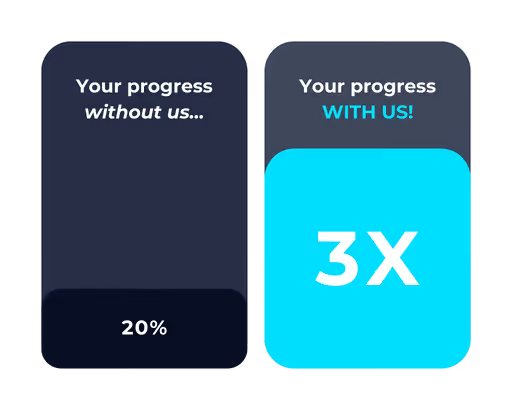
Join Thousands of GetFIT App Users Worldwide
Thousands of people around the world have already joined GetFIT App to track their nutrition, follow workout programs, and work toward their fitness goals. Join our growing global community and get the tools you need to manage your fitness journey in one place.
.webp)
Try GetFIT App for 5 days free!
Discover the premium features of the GetFIT App during a free trial: personalized calorie calculation and tracking, meal plans, recipes, workout programs, e-books, and much more. Start your transformation today!
.webp)
Dear User! Unlock your Dream Body Today!
Start your free trial today! With your premium membership, you’ll get immediate access to all the tools and content that help you lose weight, build muscle, and develop a healthy lifestyle.















































.png)