Stability ball Russian twist increases instability and core activation. Maintain balance and control the movement.

Train & diet effectively with the help of the GetFIT App. Our app tracks your calorie intake and workouts, and offers effective plans, recipes, and programs.

(Free trial for new users - cancel anytime)
Our Meal Plans


Blog Articles








Blog Articles

Stability Ball Russian Twist: A Core Exercise for Oblique Strength and Rotational Power
The stability ball Russian twist is a challenging core exercise that targets the obliques while improving rotational strength and trunk stability. Adding a stability ball increases the balance demands of the movement, forcing more muscles to work together to maintain control.
This exercise is commonly used in core workouts, athletic training programs, and functional fitness routines because it helps develop a stronger and more stable midsection.
Benefits of the Stability Ball Russian Twist
Compared to standard abdominal exercises, the stability ball Russian twist adds an element of instability that increases core activation. The movement trains rotational strength, which plays an important role in many sports and everyday activities.
Because you must constantly stabilize your body throughout the exercise, it can also help improve coordination and balance.
Muscles Worked
The primary muscles involved are the external and internal obliques, which are responsible for trunk rotation. The rectus abdominis also contributes throughout the movement.
Supporting muscles include the transverse abdominis, hip flexors, and the deep muscles surrounding the spine that help maintain stability.
How to Perform the Stability Ball Russian Twist
Starting Position
Sit on the floor with your knees bent and your feet planted. Lean your torso back slightly until you feel your core engage. Hold the stability ball with both hands in front of your chest.
More advanced lifters can elevate their feet off the floor to increase the difficulty.
Execution
Brace your abdominal muscles and maintain a neutral spine throughout the movement. Rotate your torso to one side while keeping the ball close to your body. Return to the center and rotate to the opposite side.
The rotation should come from the torso rather than from swinging the arms. Move in a slow and controlled manner without using momentum.
Breathing
Exhale as you rotate to each side.
Inhale as you return to the middle position.
Range of Motion and Technique Tips
Focus on controlled rotation instead of trying to move as far as possible. Excessive twisting is unnecessary and often reduces stability.
Keep your chest lifted and avoid rounding your back. Maintaining constant tension in the core is more important than increasing the range of motion.
Variations and Progressions
Beginner Version
Beginners can keep both feet on the floor and use a smaller range of motion. A lighter stability ball also makes the exercise easier to control.
Intermediate Version
Raising the feet slightly off the ground increases the demand on the abdominal muscles and challenges balance.
Advanced Version
More experienced lifters can use a heavier ball, slow down the tempo, or pause briefly at each side to increase time under tension.
When to Include the Stability Ball Russian Twist
This exercise works well near the end of a workout as part of a core training session. It can also be included in sport-specific programs that require rotational power and trunk stability.
Many athletes use it alongside other abdominal exercises to develop a stronger and more resilient core.
Alternative Exercises
If you do not have access to a stability ball, similar movements include weighted Russian twists, cable woodchoppers, side plank rotations, and hanging twists.
Recommended Sets and Repetitions
Beginners can start with 2 to 3 sets of 10 to 12 repetitions per side.
Intermediate and advanced lifters can perform 3 to 4 sets of 12 to 20 repetitions per side, resting approximately 45 to 60 seconds between sets.
Sample Core Workout
A simple core circuit might begin with stability ball Russian twists for 3 sets of 16 total repetitions, followed by planks for 3 sets of 40 seconds and hanging leg raises for 3 sets of 12 repetitions.
Common Mistakes
Using Momentum
Swinging quickly from side to side reduces muscle activation. Perform each repetition with control and focus on the contraction of the obliques.
Rotating With the Arms
The movement should come from the torso. Simply moving the ball with the arms decreases the effectiveness of the exercise.
Rounding the Back
Maintaining a neutral spine helps keep tension on the core and reduces unnecessary stress on the lower back.
Twisting Too Far
A moderate range of motion is usually sufficient. Quality and control matter more than excessive rotation.
The stability ball Russian twist is an effective exercise for strengthening the obliques and improving rotational core stability. Performed correctly, it can help build better body control, stronger abdominal muscles, and improved athletic performance.

More Exercises
All Exercises
.avif)


.avif)


.avif)

.avif)


.avif)
.avif)


.avif)




Everything You Need for a Fitter Body is here in GetFIT App!
Set calorie and macro goals, track your meals and activity, follow structured workout and meal plans, and monitor your progress over time. GetFIT App brings nutrition tracking, fitness planning, and everyday tools together in one simple membership.
High-Protein Recipes & Meal Plans
Discover hundreds of high-protein recipes, ready-made 4 week meal plans, and healthy meal ideas for weight loss and muscle building. Every recipe includes clear calorie and macro information, so eating for your goals is simple.


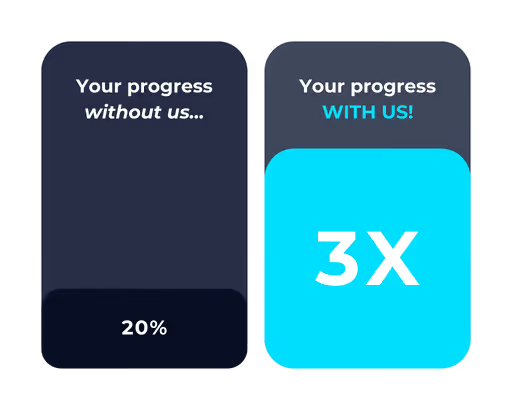
Join Thousands of GetFIT App Users Worldwide
Thousands of people around the world have already joined GetFIT App to track their nutrition, follow workout programs, and work toward their fitness goals. Join our growing global community and get the tools you need to manage your fitness journey in one place.
.webp)
Try GetFIT App for 5 days free!
Discover the premium features of the GetFIT App during a free trial: personalized calorie calculation and tracking, meal plans, recipes, workout programs, e-books, and much more. Start your transformation today!
.webp)
Dear User! Unlock your Dream Body Today!
Start your free trial today! With your premium membership, you’ll get immediate access to all the tools and content that help you lose weight, build muscle, and develop a healthy lifestyle.














































.png)