What Actually Changes When People Start Eating Much More Protein
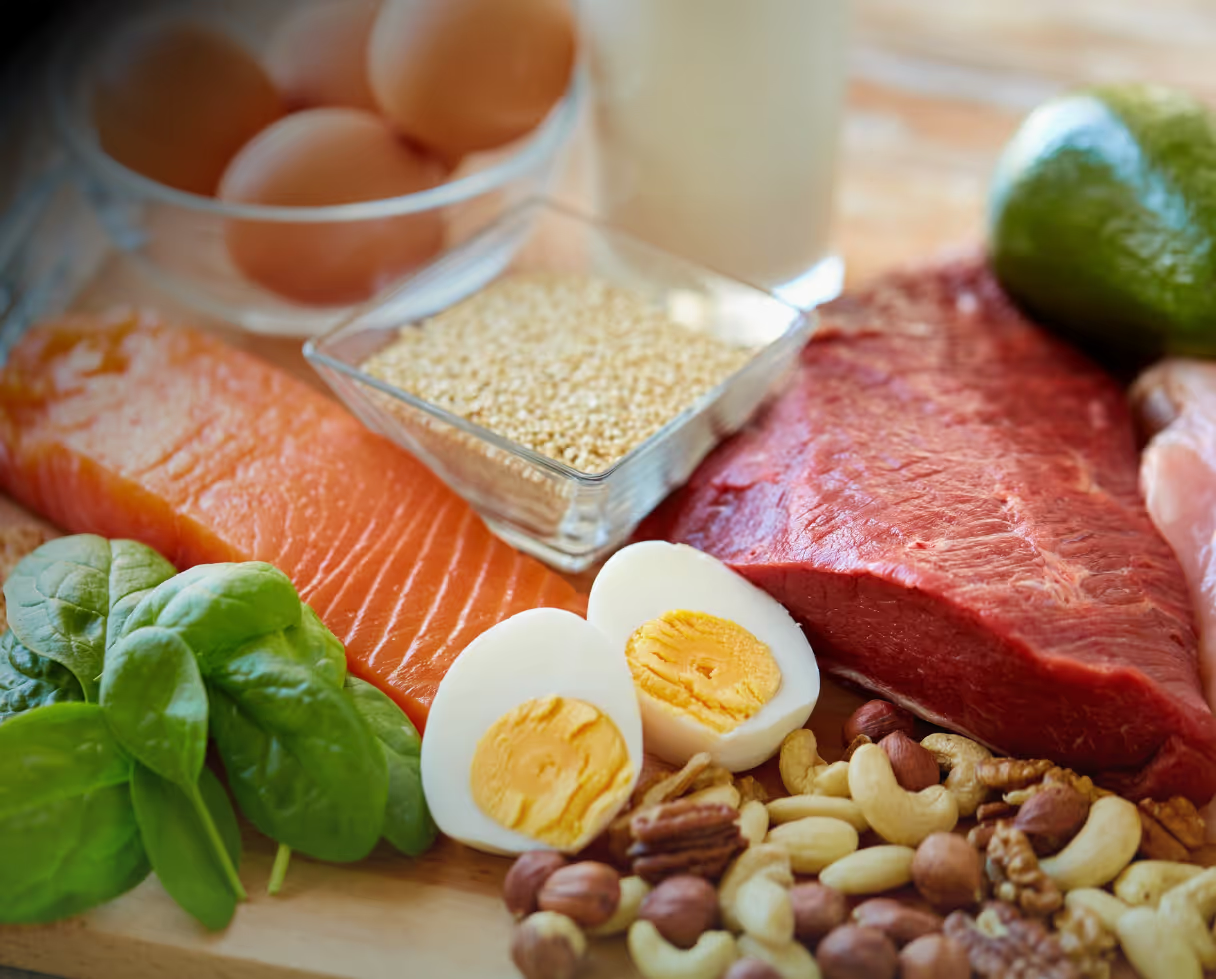
Doubling protein intake can significantly change appetite, body composition, and diet structure, but the effects are highly context-dependent. People eating low protein diets often see improved satiety and better weight control when intake increases. In resistance training populations, higher protein supports lean mass retention and modest gains, especially during calorie deficits. However, benefits plateau once sufficient intake is reached, and more protein does not automatically mean more muscle. The outcome depends on baseline diet, training, and total energy intake.

Eddz és étkezz hatékonyabban a GetFIT App segítségével. Appunk követi kalóriabeviteled, edzéseid és hatékony terveket, recepteket, programokat kínál.

(5 day free trial - cancel anytime)
More Similar Articles








Exercise Tutorials

.avif)

.avif)


.avif)


.avif)

Protein is not a magic lever, but it is a sensitive one
Protein has a different metabolic role compared to carbohydrates and fats.
It is directly involved in:
- Muscle repair and growth
- Satiety signaling
- Thermic effect of food
- Lean mass preservation during dieting
Because of this, changes in protein intake often produce noticeable shifts in how people feel and eat, even when total calories remain the same.
Doubling protein intake is not a subtle adjustment. It changes diet structure in a measurable way.
The most immediate effect is usually appetite reduction
One of the most consistent findings in nutrition research is that protein is the most satiating macronutrient.
When protein intake increases, many people naturally experience:
- Reduced hunger between meals
- Lower spontaneous snacking
- Greater fullness after eating
This effect is linked to multiple hormonal and digestive mechanisms, including changes in ghrelin and peptide YY, though the exact pathways are still being studied.
In practice, the strongest real-world effect is behavioral: people often eat less without trying.
Body composition changes depend heavily on the starting point
The impact of doubling protein intake varies significantly based on baseline intake.
For someone consuming very low protein, increasing intake can lead to:
- Better muscle retention
- Improved training recovery
- Easier fat loss during calorie restriction
For someone already consuming adequate protein, the effects are smaller and often less noticeable.
Research in resistance training populations shows that muscle growth benefits tend to plateau once protein intake reaches a sufficient threshold, commonly estimated around 1.6–2.2 g/kg/day depending on context.
Beyond that range, additional protein has diminishing returns for hypertrophy.
During calorie deficits, protein becomes more important
In energy-restricted diets, protein plays a protective role.
Higher protein intake helps preserve lean body mass by reducing muscle protein breakdown.
This is especially relevant during fat loss phases where the body is in a negative energy balance.
In these situations, doubling protein intake from a low baseline can meaningfully improve body composition outcomes, even if total weight loss remains similar.
The difference is often in what is lost, not just how much weight is lost.
The thermic effect of food quietly increases energy expenditure
Protein has a higher thermic effect compared to carbohydrates and fats.
This means the body uses more energy to digest and process it.
When protein intake increases significantly, total daily energy expenditure can rise slightly.
The effect is not large enough to drive major fat loss on its own, but it contributes to overall energy balance in a measurable way.
Over time, this can subtly influence weight stability.
Muscle gain does not scale linearly with protein intake
A common misconception is that more protein automatically equals more muscle.
Muscle growth depends on multiple factors:
- Resistance training stimulus
- Recovery capacity
- Total calorie intake
- Protein distribution across the day
Once sufficient protein is consumed, additional intake does not continuously increase muscle protein synthesis.
Instead, it reaches a saturation point where other variables become limiting factors.
This is why extremely high protein diets do not consistently outperform moderate-high intake in controlled studies.
Training context changes everything
The effects of higher protein intake are amplified or reduced depending on training status.
In resistance-trained individuals:
- Benefits are more related to recovery and lean mass retention
- Gains are modest unless baseline intake was low
In untrained individuals:
- Protein increases often coincide with rapid initial recomposition
- But training stimulus remains the primary driver of change
Without resistance training, doubling protein intake has limited impact on muscle gain, though it may still influence appetite and weight regulation.
The biggest real-world change is dietary displacement
When protein intake increases significantly, it often replaces other foods.
This can lead to:
- Reduced intake of ultra-processed snacks
- Lower overall calorie density
- More structured meal patterns
This displacement effect is one reason high-protein diets are frequently associated with fat loss in observational settings.
It is not only the protein itself, but what it replaces.
There is a ceiling where more protein stops adding value
More is not always better.
Once protein intake reaches sufficient levels for muscle maintenance and growth, additional increases show diminishing returns.
At that point, extra protein is simply:
- Additional calories
- Increased dietary cost
- Reduced flexibility in food choices
This is why most evidence-based recommendations converge on a relatively narrow effective range rather than extreme intakes.
Who benefits most from increasing protein intake
The strongest benefits of higher protein intake tend to appear in:
- Individuals in calorie deficits
- Older adults with reduced muscle protein synthesis efficiency
- People consuming low baseline protein diets
- Individuals engaged in regular resistance training
In these groups, increasing protein often produces noticeable improvements in satiety, recovery, or body composition.
Doubling protein intake can meaningfully improve appetite control, muscle retention, and diet quality, especially when starting from a low intake or during fat loss phases. However, the benefits are not infinite and depend heavily on training and total calorie balance.
Once sufficient intake is reached, additional protein adds little extra muscle-building benefit. The most important factor is not maximizing protein, but ensuring it is high enough to support recovery and consistent training. Beyond that point, results depend more on overall diet structure and training quality than further increases in protein.
Sources
- Morton, R.W. et al. Protein supplementation and resistance training hypertrophy meta-analysis
https://pubmed.ncbi.nlm.nih.gov/28698222/ - Phillips, S.M. & Van Loon, L.J.C. Dietary protein for athletes
https://pubmed.ncbi.nlm.nih.gov/24092765/ - Leidy, H.J. et al. Protein and satiety mechanisms
https://pubmed.ncbi.nlm.nih.gov/23097270/ - Pasiakos, S.M. et al. Protein and body composition during energy deficit
https://pubmed.ncbi.nlm.nih.gov/23097268/ - American College of Sports Medicine – Nutrition and Athletic Performance
https://www.acsm.org/



Get instant access to our "90 Day Summer SHRED" Challenge!
Get in Shape Fast! Try our 90-Day Summer Shape Course for FREE! Effective workout plans, recipes, diet tips, and coaching support await you!
Get access to our Guides, Ebooks for Fat Loss & Muscle Gain!
Accelerate Your Progress, Smarter! With our Premium Membership, gain access to all our science-based guides, workout programs, and eBooks—everything you need for success!


Try for FREE and transform your body, just like thousands!
You Can Transform Too with Us! Thousands of people worldwide are transforming and achieving their dream bodies with the GetFIT App. Join them and start your transformation today!
.webp)
Try our app for 5 days free!
Discover the premium features of the GetFIT App during a free trial: personalized calorie calculation and tracking, AI assistant, recipes, workout programs, e-books, and much more. Start your progress today.
.webp)
Dear User! Unlock your Dream Body Today!
Start your free trial today! With your premium membership, you’ll get immediate access to all the tools and content that help you lose weight, build muscle, and develop a healthy lifestyle.

























.png)