Tap here


Most people assume muscle growth happens because of training, but training only provides the stimulus. The actual adaptation occurs during recovery, when muscle tissue repairs and the nervous system rebounds from stress. Modern research is shifting attention toward recovery capacity as a major determinant of strength and hypertrophy outcomes. In many cases, stalled progress is caused by insufficient recovery rather than insufficient effort. The challenge is no longer how hard to train, but how much training can actually be recovered from.


Walk into almost any gym and the conversation revolves around training.
More sets.
More exercises.
More intensity.
More days per week.
Recovery is often treated as a passive process that happens automatically once the workout ends.
The problem is that training does not build muscle. Training creates disruption. Recovery creates adaptation.
Without adequate recovery, the body receives the stress signal but never fully converts it into progress.
A growing number of coaches and researchers are moving away from asking:
"How much training is optimal?"
Instead, they are asking:
"How much training can this person recover from?"
This sounds like a subtle difference, but it completely changes program design.
The focus shifts from maximizing workload to maximizing adaptation.
That distinction is becoming increasingly important as more data accumulates on fatigue management, recovery kinetics, and training sustainability.
Resistance training creates several immediate responses:
These are not the goal.
They are the trigger.
The body responds by rebuilding tissue and improving its capacity to handle future stress.
If recovery resources are insufficient, that rebuilding process becomes incomplete.
The result is often mistaken for a training problem when it is actually a recovery problem.
One of the most overlooked findings in exercise science is how differently people recover from the same training session.
Factors influencing recovery include:
Two people can complete identical workouts and require completely different recovery periods before they are ready to adapt again.
This helps explain why copying someone else's program often produces disappointing results.
A workout creates both:
Performance reflects the balance between those two forces.
When fitness rises faster than fatigue, progress occurs.
When fatigue accumulates faster than adaptation, performance stalls.
This is why many lifters feel stuck despite increasing effort.
They are generating more fatigue than growth.
The issue is not insufficient work. It is insufficient recovery relative to the work being performed.
Among all recovery variables, sleep consistently stands out in research.
Sleep influences:
Even modest sleep restriction has been associated with impaired recovery and reduced athletic performance.
Interestingly, many lifters spend hours optimizing workout details while overlooking one of the largest drivers of adaptation.
Recovery is an energy-intensive process.
Building muscle requires:
A surprising number of plateaus occur because individuals are unintentionally under-eating.
This becomes especially common during aggressive fat-loss phases.
Tools such as a calorie calculator, macronutrient calculator, or protein calculator can help identify whether recovery resources match training demands.
One of the biggest changes in modern hypertrophy coaching is the growing acceptance that more volume is not always better.
Research continues to support a dose-response relationship between training volume and muscle growth.
However, that relationship eventually flattens.
Beyond a certain point:
This has led many coaches to prioritize the minimum amount of training needed to stimulate growth rather than the maximum amount an athlete can tolerate.
Muscle soreness is often used as a recovery gauge.
The problem is that soreness and readiness are not the same thing.
A muscle may feel recovered while the nervous system remains fatigued.
This is particularly relevant for:
When neural fatigue accumulates, performance often drops despite muscles feeling physically ready.
Beginners can make progress despite poor recovery habits because almost any stimulus works initially.
As training age increases, progress becomes harder to earn.
The margin for error shrinks.
Many advanced lifters discover that improving sleep, stress management, and nutrition produces more progress than adding another exercise or training day.
This is one reason why recovery has become a central topic in modern evidence-based coaching.
The hardest-working athlete is not always the one who improves the fastest.
Sometimes the athlete making the best progress is the one who balances stress and recovery most effectively.
That creates a paradox.
The goal is not to maximize training.
The goal is to maximize adaptation.
Training is only one half of that equation.
If progress has stalled, the answer may not be a new workout program, more exercises, or higher intensity. Recovery determines whether training stress becomes muscle, strength, and performance improvements or simply accumulates as fatigue. Better sleep, adequate nutrition, and intelligent fatigue management often produce greater returns than adding more work. The most effective training plan is not the hardest one. It is the one that allows consistent adaptation over months and years.
Sources



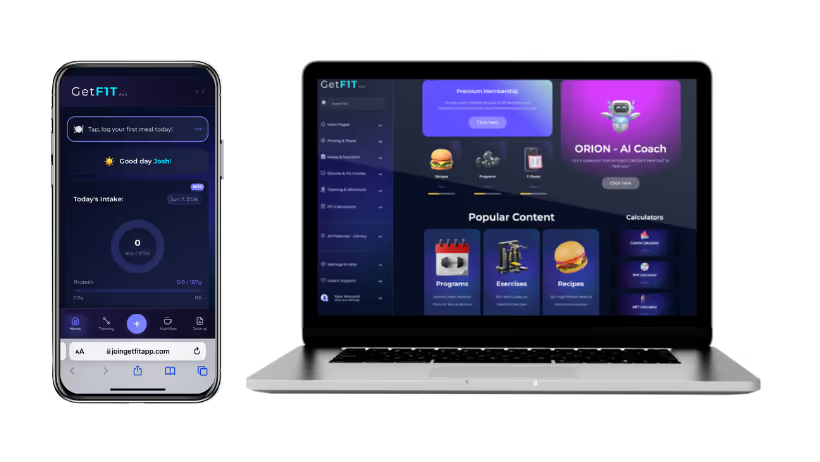
Set calorie and macro goals, track your meals and activity, follow structured workout and meal plans, and monitor your progress over time. GetFIT App brings nutrition tracking, fitness planning, and everyday tools together in one simple membership.
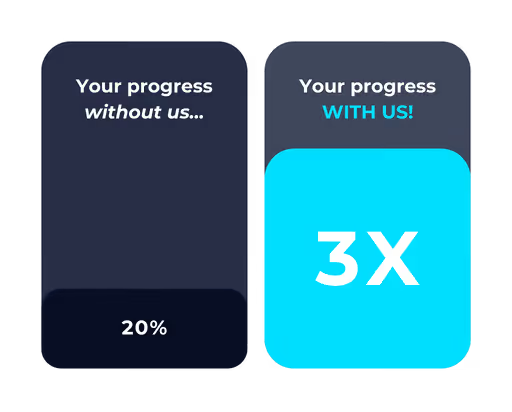
Thousands of people around the world have already joined GetFIT App to track their nutrition, follow workout programs, and work toward their fitness goals. Join our growing global community and get the tools you need to manage your fitness journey in one place.
Track your daily calories and macros, log your workouts, monitor your weight and measurements, and see your progress over time. GetFIT App puts everything you need to stay on track in one place.

.webp)
Discover the premium features of the GetFIT App during a free trial: personalized calorie calculation and tracking, meal plans, recipes, workout programs, e-books, and much more. Start your transformation today!
.webp)
Start your free trial today! With your premium membership, you’ll get immediate access to all the tools and content that help you lose weight, build muscle, and develop a healthy lifestyle.










.avif)


.avif)


.avif)


.avif)















































.png)